 Dutch Golden Age
Preview image — download the full-resolution TIF after purchase
Basic Information
Historical Context
This painting is in fact Meindert Hobbema's famous 1689 work The Avenue at Middelharnis, now in the National Gallery, London. Hobbema was a pupil of Jacob van Ruisdael and, like Cuyp, belongs to the Dutch Golden Age landscape tradition, but his style differs markedly. The painting is renowned for its highly perspective avenue composition.
Artistic Appreciation
The painting employs exceptionally precise single-point perspective to depict the avenue — the flanking trees guide the eye straight to the distant horizon, creating a powerful spatial recession. Hobbema's brushwork is finer and more realistic than Cuyp's, and the geometric rigor of the composition is more pronounced. Although this painting is often misattributed to Cuyp, its unique perspective treatment and meticulous touch clearly point to Hobbema's creative characteristics.
The Avenue at Meerdervoort
Visual Description
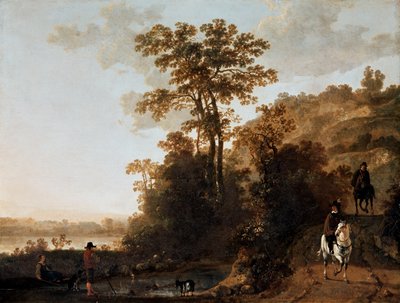
At the center of the canvas, a straight avenue extends into the distance, lined with tall trees on both sides. Six or seven figures are visible on the avenue, along with three horses, two cows, and a dog at the roadside. The outline of a manor and town can be seen in the distance.
Specifications
Order a Print
museum-quality prints of this artwork, shipped to your door
Subscribers save 30% on all prints
Free standard shipping (5-10 business days) · Ships from US
Instant download after payment — $1.99 per artwork
Re-download anytime from your account — no expiration
Commercial license included in every purchase
Or subscribe for $9.99/month — unlimited downloads
Community
Customer Reviews
Leave a Review
Loading comments...