 American Realism
Preview image — download the full-resolution TIF after purchase
Basic Information
Historical Context
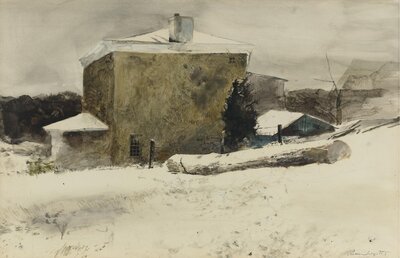
Painted in 1953, depicting a dilapidated outbuilding — possibly part of the Kuerner Farm in Chadds Ford, Pennsylvania. "The Corner" refers both to the physical corner of the property and metaphorically to a marginal, forgotten space in time and memory. This work exemplifies Wyeth's sustained attention to abandoned and neglected places, which he believed contained deeper emotional truths than pristine subjects. Visual Description A stark winter rural landscape. A weathered, dilapidated shed or outbuilding, partially collapsed or in disrepair, surrounded by heavy snow. Broken fencing, scattered debris, and farm implements (barrels, crates, metal drums) are partially buried in snowdrifts. Bare, skeletal trees rise behind the building. The foreground is dominated by an expansive, nearly empty snowfield. The palette is nearly monochromatic: whites and off-whites in snow with subtle variations of cream, ivory, and pale gray; earth tones (browns, taupes, gray-browns) for wooden structures; slate grays and blue-grays for the overcast sky; near-black accents in building interiors and dark tree trunks; sparse warm touches of ochre and rust in exposed wood. Artistic Analysis The Corner is a peak of Wyeth's "existential solitude." The vast snow-filled foreground — occupying roughly 60% of the canvas — creates psychological tension through emptiness, becoming active, meaningful content through its very absence. The viewer is positioned as an intruder or witness, invited to construct narratives about who lived here and what transpired. "The Corner" becomes a metaphor for marginality — physical, temporal, and mnemonic. Wyeth's departure from his father's illustrative romanticism toward a more austere, modernist-influenced realism is fully visible. The compositional boldness — risking so much empty space — demonstrates confidence in negative space as active, meaningful content.
Artistic Appreciation
The Corner is a peak of Wyeth's "existential solitude." The vast snow-filled foreground — occupying roughly 60% of the canvas — creates psychological tension through emptiness, becoming active, meaningful content through its very absence. The viewer is positioned as an intruder or witness, invited to construct narratives about who lived here and what transpired. "The Corner" becomes a metaphor for marginality — physical, temporal, and mnemonic. Wyeth's departure from his father's illustrative romanticism toward a more austere, modernist-influenced realism is fully visible. The compositional boldness — risking so much empty space — demonstrates confidence in negative space as active, meaningful content.
The Corner
Visual Description
A stark winter rural landscape. A weathered, dilapidated shed or outbuilding, partially collapsed or in disrepair, surrounded by heavy snow. Broken fencing, scattered debris, and farm implements (barrels, crates, metal drums) are partially buried in snowdrifts. Bare, skeletal trees rise behind the building. The foreground is dominated by an expansive, nearly empty snowfield. The palette is nearly monochromatic: whites and off-whites in snow with subtle variations of cream, ivory, and pale gray; earth tones (browns, taupes, gray-browns) for wooden structures; slate grays and blue-grays for the overcast sky; near-black accents in building interiors and dark tree trunks; sparse warm touches of ochre and rust in exposed wood. Artistic Analysis The Corner is a peak of Wyeth's "existential solitude." The vast snow-filled foreground — occupying roughly 60% of the canvas — creates psychological tension through emptiness, becoming active, meaningful content through its very absence. The viewer is positioned as an intruder or witness, invited to construct narratives about who lived here and what transpired. "The Corner" becomes a metaphor for marginality — physical, temporal, and mnemonic. Wyeth's departure from his father's illustrative romanticism toward a more austere, modernist-influenced realism is fully visible. The compositional boldness — risking so much empty space — demonstrates confidence in negative space as active, meaningful content.
Specifications
Order a Print
museum-quality prints of this artwork, shipped to your door
Subscribers save 30% on all prints
Free standard shipping (5-10 business days) · Ships from US
Instant download after payment — $1.99 per artwork
Re-download anytime from your account — no expiration
Commercial license included in every purchase
Or subscribe for $9.99/month — unlimited downloads
Community
Customer Reviews
Leave a Review
Loading comments...