 American Realism
Preview image — download the full-resolution TIF after purchase
Basic Information
Historical Context
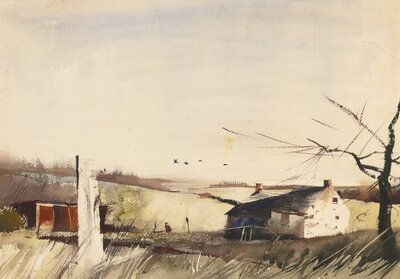
This painting belongs to Wyeth's 1950s-60s series depicting the Kuerner Farm in Chadds Ford, Pennsylvania. Karl Kuerner, the German immigrant farmer who owned the property, fascinated Wyeth from his teenage years. The painting documents agricultural practices — horse-drawn wagons, hand-stacked hay — that were already becoming obsolete by the mid-20th century, making Wyeth both artist and documentarian of a disappearing way of life. Visual Description The composition features a weathered wooden hay wagon positioned on the crest of a gently rolling hill, silhouetted against a pale, expansive sky. The wagon appears empty, with tall wheels and a simple box structure. To the right sits a substantial haystack beside a blue farm cart, with wooden fencing and a partial red barn visible at the far right edge. Several chickens scatter in the foreground and middle ground. The terrain is an open grassy field with subtle undulations. Dominant greens range from rich emerald to olive and brownish-green, built up in layered, transparent watercolor washes. The pale sky shows minimal pale blue-gray cloud formations. The blue cart and red barn provide limited chromatic accents. Artistic Analysis The Hay Wagon transforms a humble utilitarian object into something almost iconic or symbolic through the power of silhouette — the empty wagon against the vast sky achieves monumentality. The absence of human figures, while scattered chickens and stacked hay imply recent activity, creates a meditation on absence characteristic of Wyeth's psychological realism. The dramatic shadow from the barn creates diagonal movement counterbalancing the strong horizontality. Wyeth's watercolor technique demonstrates extraordinary control — the granular, almost tactile quality of the grass achieved through drybrush over wet washes creates visual texture that paradoxically suggests both detail and atmospheric haze.
Artistic Appreciation
The Hay Wagon transforms a humble utilitarian object into something almost iconic or symbolic through the power of silhouette — the empty wagon against the vast sky achieves monumentality. The absence of human figures, while scattered chickens and stacked hay imply recent activity, creates a meditation on absence characteristic of Wyeth's psychological realism. The dramatic shadow from the barn creates diagonal movement counterbalancing the strong horizontality. Wyeth's watercolor technique demonstrates extraordinary control — the granular, almost tactile quality of the grass achieved through drybrush over wet washes creates visual texture that paradoxically suggests both detail and atmospheric haze.
The Hay Wagon
Visual Description
The composition features a weathered wooden hay wagon positioned on the crest of a gently rolling hill, silhouetted against a pale, expansive sky. The wagon appears empty, with tall wheels and a simple box structure. To the right sits a substantial haystack beside a blue farm cart, with wooden fencing and a partial red barn visible at the far right edge. Several chickens scatter in the foreground and middle ground. The terrain is an open grassy field with subtle undulations. Dominant greens range from rich emerald to olive and brownish-green, built up in layered, transparent watercolor washes. The pale sky shows minimal pale blue-gray cloud formations. The blue cart and red barn provide limited chromatic accents. Artistic Analysis The Hay Wagon transforms a humble utilitarian object into something almost iconic or symbolic through the power of silhouette — the empty wagon against the vast sky achieves monumentality. The absence of human figures, while scattered chickens and stacked hay imply recent activity, creates a meditation on absence characteristic of Wyeth's psychological realism. The dramatic shadow from the barn creates diagonal movement counterbalancing the strong horizontality. Wyeth's watercolor technique demonstrates extraordinary control — the granular, almost tactile quality of the grass achieved through drybrush over wet washes creates visual texture that paradoxically suggests both detail and atmospheric haze.
Specifications
Order a Print
museum-quality prints of this artwork, shipped to your door
Subscribers save 30% on all prints
Free standard shipping (5-10 business days) · Ships from US
Instant download after payment — $1.99 per artwork
Re-download anytime from your account — no expiration
Commercial license included in every purchase
Or subscribe for $9.99/month — unlimited downloads
Community
Customer Reviews
Leave a Review
Loading comments...