 American Realism
Preview image — download the full-resolution TIF after purchase
Basic Information
Historical Context
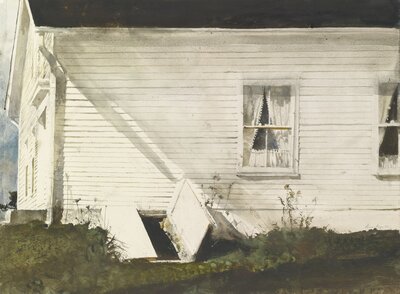
Painted in 1964, depicting a mill or workshop building in Chadds Ford, Pennsylvania, or possibly Maine. Wyeth maintained a lifelong fascination with rural buildings as psychological portraits — structures that bear the marks of time, use, and human presence. The work belongs to his mature period, following Christina's World (1948), when he had refined his ability to find profound meaning in overlooked American vernacular architecture. Visual Description The composition shows the corner of a clapboard structure from a slightly low angle. Horizontal wooden siding shows pronounced wear, staining, and age. A twelve-paned window dominates the right portion with dark interior spaces and hints of blue and white objects within. A large white sail or canvas awning is partially visible to the right of the window. Two wooden ramps angle down from the building's foundation into shadow. In the foreground sits a small, weathered boat with partial lettering visible on its stern. Ground is covered in coarse, wild grass rendered with drybrush technique. The palette features warm and cool grays in the siding, olive and sage greens in the grassy foreground, deep browns and blacks in shadow areas, and stark whites in the sail and window mullions. Artistic Analysis The Mill demonstrates Wyeth's compositional daring. By cropping tightly and shooting upward, he abstracts the structure into geometric planes while maintaining documentary specificity. The window operates as a painting-within-a-painting. The small boat's placement creates a narrative puzzle — why a watercraft at a mill? The peeling letters on the boat suggest identities now lost to time. The watercolor technique builds density through drybrush — dragging nearly dry brushes across the paper's tooth to create granular, textured surfaces that mimic weathered wood and rough grass. The painting transforms documentary observation into emotional experience through technical precision and compositional boldness.
Artistic Appreciation
The Mill demonstrates Wyeth's compositional daring. By cropping tightly and shooting upward, he abstracts the structure into geometric planes while maintaining documentary specificity. The window operates as a painting-within-a-painting. The small boat's placement creates a narrative puzzle — why a watercraft at a mill? The peeling letters on the boat suggest identities now lost to time. The watercolor technique builds density through drybrush — dragging nearly dry brushes across the paper's tooth to create granular, textured surfaces that mimic weathered wood and rough grass. The painting transforms documentary observation into emotional experience through technical precision and compositional boldness.
The Mill
Visual Description
The composition shows the corner of a clapboard structure from a slightly low angle. Horizontal wooden siding shows pronounced wear, staining, and age. A twelve-paned window dominates the right portion with dark interior spaces and hints of blue and white objects within. A large white sail or canvas awning is partially visible to the right of the window. Two wooden ramps angle down from the building's foundation into shadow. In the foreground sits a small, weathered boat with partial lettering visible on its stern. Ground is covered in coarse, wild grass rendered with drybrush technique. The palette features warm and cool grays in the siding, olive and sage greens in the grassy foreground, deep browns and blacks in shadow areas, and stark whites in the sail and window mullions. Artistic Analysis The Mill demonstrates Wyeth's compositional daring. By cropping tightly and shooting upward, he abstracts the structure into geometric planes while maintaining documentary specificity. The window operates as a painting-within-a-painting. The small boat's placement creates a narrative puzzle — why a watercraft at a mill? The peeling letters on the boat suggest identities now lost to time. The watercolor technique builds density through drybrush — dragging nearly dry brushes across the paper's tooth to create granular, textured surfaces that mimic weathered wood and rough grass. The painting transforms documentary observation into emotional experience through technical precision and compositional boldness.
Specifications
Order a Print
museum-quality prints of this artwork, shipped to your door
Subscribers save 30% on all prints
Free standard shipping (5-10 business days) · Ships from US
Instant download after payment — $1.99 per artwork
Re-download anytime from your account — no expiration
Commercial license included in every purchase
Or subscribe for $9.99/month — unlimited downloads
Community
Customer Reviews
Leave a Review
Loading comments...