 American Realism
Preview image — download the full-resolution TIF after purchase
Basic Information
Historical Context
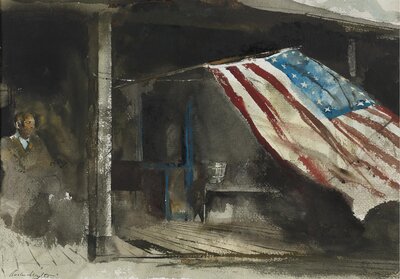
This is the portrait version of The Patriot (see also No. 8), painted in the same year. It depicts Ralph Cline with a warm, engaging smile, his back visible in an octagonal mirror's reflection, creating a complex dialogue about identity and perspective. Visual Description An elderly African American man — Ralph Cline — faces the viewer with a warm smile revealing a gap in his teeth. He wears a heavy cream-colored cable-knit cardigan over a white turtleneck, with a dark collar visible beneath. He is bald, with an expression conveying dignity, warmth, and quiet resilience. Behind him hangs an octagonal mirror — a traditional colonial American "witch mirror" form — reflecting his back and a winter landscape visible through a window, with bare trees and muted light. The wall shows meticulous attention to surface — subtle stains, hairline cracks, and the accumulation of time. The palette features warm ochres and browns for the wall, cream and off-white in the sweater, and cooler blue-grays in the reflected winter landscape. Artistic Analysis The octagonal mirror introduces layers of meaning absent from the flag version (No. 8). We see Cline both directly (open, smiling, present) and indirectly (turned away, contemplative, integrated into the landscape), suggesting the multiple dimensions of personhood: public warmth and private interiority. The mirror collapses space, bringing the exterior winter world into intimate relationship with the interior figure. Wyeth's tempera technique achieves hairline precision — every thread of the sweater, every pore of the wall, every glint in Cline's eyes registers with tactile immediacy. This "sacred attention" — the act of looking itself as a form of respect — elevates individual particularity to universal significance.
Artistic Appreciation
The octagonal mirror introduces layers of meaning absent from the flag version (No. 8). We see Cline both directly (open, smiling, present) and indirectly (turned away, contemplative, integrated into the landscape), suggesting the multiple dimensions of personhood: public warmth and private interiority. The mirror collapses space, bringing the exterior winter world into intimate relationship with the interior figure. Wyeth's tempera technique achieves hairline precision — every thread of the sweater, every pore of the wall, every glint in Cline's eyes registers with tactile immediacy. This "sacred attention" — the act of looking itself as a form of respect — elevates individual particularity to universal significance.
The Patriot (Portrait Version)
Visual Description
An elderly African American man — Ralph Cline — faces the viewer with a warm smile revealing a gap in his teeth. He wears a heavy cream-colored cable-knit cardigan over a white turtleneck, with a dark collar visible beneath. He is bald, with an expression conveying dignity, warmth, and quiet resilience. Behind him hangs an octagonal mirror — a traditional colonial American "witch mirror" form — reflecting his back and a winter landscape visible through a window, with bare trees and muted light. The wall shows meticulous attention to surface — subtle stains, hairline cracks, and the accumulation of time. The palette features warm ochres and browns for the wall, cream and off-white in the sweater, and cooler blue-grays in the reflected winter landscape. Artistic Analysis The octagonal mirror introduces layers of meaning absent from the flag version (No. 8). We see Cline both directly (open, smiling, present) and indirectly (turned away, contemplative, integrated into the landscape), suggesting the multiple dimensions of personhood: public warmth and private interiority. The mirror collapses space, bringing the exterior winter world into intimate relationship with the interior figure. Wyeth's tempera technique achieves hairline precision — every thread of the sweater, every pore of the wall, every glint in Cline's eyes registers with tactile immediacy. This "sacred attention" — the act of looking itself as a form of respect — elevates individual particularity to universal significance.
Specifications
Order a Print
museum-quality prints of this artwork, shipped to your door
Subscribers save 30% on all prints
Free standard shipping (5-10 business days) · Ships from US
Instant download after payment — $1.99 per artwork
Re-download anytime from your account — no expiration
Commercial license included in every purchase
Or subscribe for $9.99/month — unlimited downloads
Community
Customer Reviews
Leave a Review
Loading comments...